
Since infrastructure projects have long gestation periods, investors need to enter them with a long horizon of at least 10 years.

'.. if you do not want to take the asset allocation call.'' 'This category of funds can offer optimum risk-adjusted returns.'
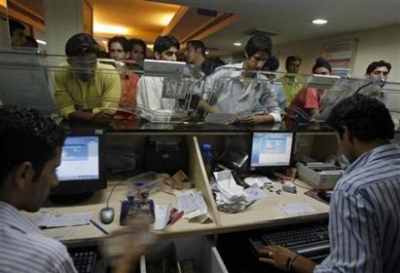
Criterion for corporates will effectively rule out entry for business houses.

Earlier this month, RBI had raised loan to value ratio to 75 per cent from 60 per cent earlier.

Trouble at a single bank among the top five most connected lenders could wipe out nearly 50% of Tier I capital

P2P platforms do not have the safety net. Instead of playing the role of an intermediary, if they run their own balance sheets for safety and growth, it's a recipe for disaster, warns Tamal Bandyopadhyay.

India's largest carmaker, Maruti Suzuki India (MSIL), is focused on getting 50 per cent of its customers' car-financing transactions executed through its Smart Finance platform by next year. Shashank Srivastava, executive director-sales, MSIL, said this will help the company turn its website into a single-window channel through which customers can select their models, find dealers, and arrange financing. He said there is a likelihood that 100 per cent of its customers availing of financing will take it through Smart Finance. To date, the company has disbursed Rs 6,500-crore loans via Smart Finance to around 100,000 customers, accounting for 28 per cent of all finance-based car-purchase transactions for the company.

The Rs 6,560-crore initial public offer of Bajaj Housing Finance Ltd received 63.60 times subscription on September 11, the last day of bidding, amid overwhelming participation from institutional buyers. The initial share sale had a price band for the offer at Rs 66-70 per share.

The RBI working group's proposal to allow corporate houses to set up banks is a 'good-looking' step in a 'bad direction' and may lead to crony capitalism and eventual financial instability, former chief economist of World Bank Kaushik Basu said on Thursday. Basu further said that there is a good reason why all successful economies have a clear dividing line between industries and corporations on the one hand, and banks and lending organisations on the other.

The banking regulator was uncomfortable with the runaway pace at which consumer credit was growing.

The Ministry of Corporate Affairs had taken various steps to protect small investors.

The government liberalised FDI policy in sectors, including multi-brand retail, single-brand retail, commodity exchanges, power exchanges, broadcasting, non-banking financial institutions and asset reconstruction companies.

The drop was the result of the change in FDI rules, which was amplified by the border standoff between India and China.

After the finance minister directed public sector banks to join the account aggregator (AA) ecosystem, 5-6 major ones, including State Bank of India (SBI) and Bank of Baroda are expected to go live by July-end. Sahmati, an industry alliance for the AA ecosystem, has been working with PSU banks to get them onboarded for quite some time now. So far, Union Bank of India and Punjab National Bank (PNB) have gone live on the AA ecosystem. While Union Bank has been live for a while, PNB went live earlier this month.

The home loan top-up, a kind of secured multipurpose personal loan, is on the regulator's radar, points out Tamal Bandyopadhyay.

Adani Group is expected to report a 20 per cent rise in its earnings before interest, tax, depreciation, and amortisation (Ebitda) at Rs 61,200 crore for the year that ended in March 2023 (2022-23, or FY23), according to a note submitted by the group to lenders recently. The group had earned Ebitda of Rs 57,299 crore in the preceding financial year that ended in March 2022 (2021-22). The group's gross debt was Rs 2.27 trillion as of March 31, 2023, and has projected to not take on additional debt until it lowers its existing one.

Despite multiple headwinds at the start of 2023, the Indian markets delivered a strong performance, posting 19-20 per cent growth for the year. Even as new records were set, investor sentiment remains strong going into 2024, given the lower inflation, expectations of steady to lower interest rates, higher economic growth, and strong inflows. However, the overriding concern for most brokerages is valuations.

The bulk of an investor's portfolio should be in shorter-duration funds of up to one year portfolio duration.

'Building a credit history is a gradual process that requires at least 6-12 months of consistent credit activity.'

These 10 stocks represent the best mix of value and growth, offering relatively low price-to-earnings and price-to-book ratios, a high return on equity, and sufficiently high potential from current levels.

About 300 fintech firms are under investigation by the ED for allegedly partnering 38 non-banking financial companies for predatory lending practices to charge borrowers high interest rates.


Redress for a victim is not easy. It is not really painful to file a cyber-crime complaint.
But someone who is technically unsophisticated enough to fall for a scam will find it hard to navigate the processes, points out Devangshu Datta.

The move by the central bank follows concerns over tight liquidity conditions and banks' unwillingness to lend to NBFCs.

NBFCs which have not met Sebi criteria will face tough action.

Loan against gold as a product is catching on fast. Let's keep the momentum going, but aim for sustainable growth. A few bad apples should not ruin the brunch, argues Tamal Bandyopadhyay.
Stemming from the default of IL&FS in September, on various debt instruments including commercial papers, bonds and loans, the financial sector has been facing a liquidity crunch for the last eight to ten weeks.

RBI is expecting the rupee to stay close to Rs 75 to a dollar, as COVID-19 forces foreign funds to withdraw from emerging markets.

The income-tax (I-T) department is working on integrating the new e-filing portal with stock exchanges to help tax authorities track trade transactions, including futures and options. The integrated system will look at discrepancies between the data disclosed by an assessee and match it with data fetched from stock exchanges, using artificial intelligence, said two officials in the know. This will help detect and red-flag such matters, particularly those related to non-filers of income-tax return (ITR).

While the RBI's guidelines aim to streamline the loan closure process, borrowers must remain proactive.

For the time being, digital lending remains a grey area, notes Tamal Bandyopadhyay.

Indiabulls has received Sebi's approval to enter the mutual fund operations.

The top-100 wealth creators generated Rs 49 lakh crore during 2014-19, the highest-ever quantum of wealth added, according to Motilal Oswal's Annual Wealth Creation Study 2019. According to the study, Reliance Industries, Indiabulls Ventures and IndusInd Bank are the biggest, fastest and most-consistent wealth creators, respectively. The number of PSUs in the top-100 wealth creators is only nine, namely IOC, BPCL, HPCL, Power Grid Corporation, Petronet LNG, Indraprastha Gas, LIC Housing, Bharat Electronics and NBCC.

Why did the company zero in on RBL Bank to understand the business of banking? While the M&M investors heaved a sigh of relief, one gentleman must have been all smiles after this, RBL Bank MD and CEO R Subramaniakumar, notes Tamal Bandyopadhyay.

The credit guarantee cover under the scheme would be both transaction-based (for single eligible borrowers) and umbrella-based (for a group of eligible borrowers).

India Inc has reported a muted start to the financial year 2024-25, with a decline in net earnings and a modest single-digit uptick in revenues. An analysis of 488 companies that have released their results for the June 2024 quarter reveals a 1.6 per cent year-on-year (Y-o-Y) drop in combined net profit -- the weakest performance in the past seven quarters. In stark contrast, the combined net profit of these companies experienced a 13.6 per cent Y-o-Y increase in the previous quarter (Q4FY24) and a 65.2 per cent Y-o-Y rise in Q1FY24.

In September, JSW MG Motor India, the newly minted joint venture between SAIC Motor, which is present in 100 countries, and Indian conglomerate JSW Group, launched the Windsor, an electric car that introduced battery as a service (BaaS).

The government would be ironing out issues related to the controversial 'bail-in' clause in the earlier Bill, explore hiking the deposit insurance cover of customers, and decide whether the resolution framework should apply to public sector banks.

'Given the emerging trends, it may be time for India to embrace digital banking,' notes Pradipta Bagchi.

The issue will comprise a secondary share sale worth Rs 600 crore by private equity major Everstone Capital and fresh fundraising worth Rs 400 crore.
